At Pegasus we draw great pleasure in celebrating the work of our colleagues. Although Book Beat only reviews poetry, we will be happy to announce books members publish in other genres.
If you are a member of the Kentucky State Poetry Society and interested in having a recently published work reviewed for publication in Pegasus, please contact:
Elaine Fowler Palencia, 3006 Valleybrook Drive, Champaign, IL 61822
(217) 621-1093
Pauletta Hansel, Will There Also Be Singing? Poems.
Lexington KY: Shadelandhouse Modern Press, 2024. 50pp. $14.00.

You just know that if a book starts with an epigraph by Bertolt Brecht, things are going to get serious in a hurry: In the dark times/Will there also be singing? / Yes, there will be singing/About the dark times.
Pauletta Hansel is from eastern Kentucky. Finely controlling her righteous wrath, she begins with a found poem, “Listen, America,” about the depredations of coal in her native hills. This quote from a miner says, “The X-rays of my lungs look like the inside/of a mountain we done mined. Scars built up around the coal and rock dust I sucked in.” “Harlan County, USA (2019)” concerns miners who blocked a coal train owned by bankrupt Blackjewel Coal, which continued to sell coal without paying them. “No Friend of Coal,” a reference to Friend of Coal license plates in Kentucky, describes a strip-mining silt pond that breaks during a flood and sweeps away homes. Hansel commands both the view of the insider and the exile. The poems “A Word Like Home: A Cento,” “Mountains”, and “My People” speak to a longing for what has been left behind by out-migration to a northerly city. But is home still there, or just an illusion of who and what was ever mine, as politics creates a new landscape of division?
Various poetic forms are used—the cento, the golden shovel—as well as quotes from news sources. Several poems feature Biblical quotes that support the general tone of lamentation. One of the most interesting hybrid forms appears in James Hathaway Robinson: A conversation in prose and poetry, 1919-2023. Hansel’s poem, on the left side of the page, discusses whiteness and blackness in Cincinnati, and living in a racially mixed (or it was) neighborhood. The material on the right centers on the work of Robinson, a black teacher from Sharpsburg KY who wrote investigative pieces like “the Negro in Cincinnati” a century before. The two voices are to be read left, then right, as a kind of call and response of two migrant populations, in which the poet must acknowledge, “our Black Lives Matter signs staked in yards/where black children once played.”
The final section extends this topic, beginning with President’s Day 2021, in which the issue of race has been exacerbated by the acts of the current president and his administration. It is an opportunity to interrogate oneself as well: “I wear my whiteness lightly, /like a down-filled coat. I hardly know/it’s there, unless I’m called out to the cold/without it. And, friend, how often am I/called to do that?” En/vy, begins with a shrewd nod to Auden, then doubles down on what is happening to us as a nation: “The evil eye is cast, /uneasy/from the head/that wears the crown.” After a tart message addressed to “Drumpf” we go back to 2016. In On Grief: November 2016, the author works through the stages of grief while caring for her mother, who is disappearing into dementia, and inevitably links this grief to the 2016 national campaign and election. She struggles to implement the sixth stage of grief– find meaning–and is able to do so in her relationship with her mother. As for the rest, “I’m going to /stick with anger, /stage two.”
But there is still necessary work to be done. Com/passion unpacks the roots of that word and does find a path toward meaning: to be with people in their suffering, “my heart on permanent loan.” The final poem, “Dyptych,” leaves us with a powerful image of unity, and a responsibility to find one’s own story.
The discoloration on some pages, which looks like water damage or coal dust, is deliberate—a brilliant design feature reminding us that everything touched by corporate selfishness will be stained.
Hansel’s brave singing about dark times is a must read and a crucial public service.
Matthew Sidney Parsons, Mountain Roosters.
Ft. Mitchell KY: Pine Row Press. 2024. 92 pp.
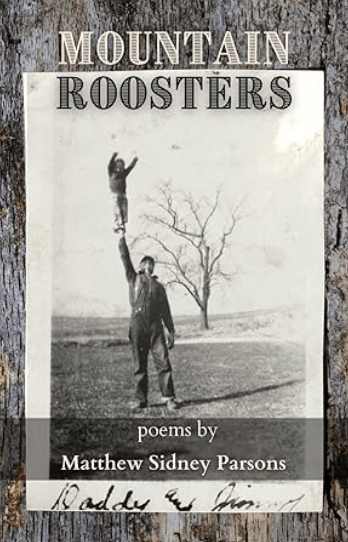
When I started reading Mountain Roosters, a poetic compilation of male voices and situations that explore notions of country masculinity, in the back of my mind Mo Bandy and Joe Stampley started singing “Just Good Ol’ Boys.” Then I realized there’s a lot more going on here than men flirting with bodily harm and crime because it’s just their style and they mean no harm, bless their hearts. No, this is a deeper and more complicated look at masculinity, starting with a quote from Robert Bly’s Iron John: A Book About Men, which sends us back to “ancient stories” that “give both the light and dark sides of manhood, the admirable and the dangerous.” In the title poem, though the speaker is “hung up and over,” he notes that mountain roosters are “clever peckers.”
Parsons is a musician (see his Youtube videos). Many poems use rhyme, meter, and clever word play the way songs do, begging to be put to music. Here is “The Almosts” in its entirety. It tackles authenticity, a concept that comes up frequently: “The pleated pants / armchair lifer. / The not-quite-a-writer—/ got no grit, no fight. / You got to be able to bite /right through a steel pipe.”
Much energy comes from the rhythms of everyday talk, lending intimacy to the stories and to our connection with the male subjects, who are often named in parentheses under a poem’s title. In “Planned Parenthood,” Sid remembers his grandfather: “He was good as grandpas go/until his legs began to slow/and rocks had grown inside his lungs/and anger touched his dancing tongue. / He didn’t mean to call me lazy. / That’s just some crazy joke he told/because he didn’t feel like growing old.” It’s the oral culture of Appalachia talking, y’all.
Several such mentors are honored, as in “My Father as an Inuit Hunter (“Lord knows he gets shit done”) but we’re warned off some would-be guides. “Forefathers” draws a bead on the authors of the Constitution: “In light, these historical giants appear Lilliputian.” And in “The Folks Who Speak in Acronyms,” there’s no respect for “The sinning, / grinning, judging your ass in the end/ kind of men.”
Throughout, there’s a demand to, as a great uncle of mine put it, “take me as I is,” and to reject male stereotypes. Houston, in “Watching Myself,” says, “Maybe I’m not as dumb as you thought/ just because I got a wad of dip in my lip.” “The Rug” extends that tone: “Don’t want to be some/reckless western honky/with a northern voice / and fake eastern pride.” Meanwhile, life lessons are learned, as in “The Original Delorean:” As you get older you’ll find/today just don’t do it for you anymore.” “Marriage and Parenthood” finds “the poor bastard spider caught/in a web of its own making.” Life forces honest men to turn to violence, in “Old Pedro,” and to drink. In “Ridiculous on a Monday,” Roger “was drunk all day on Sunday, / sauced like a braised leg of lamb—a living keg full of wine” as he mourned a death.And how to position oneself in society, when society deals in stereotypes? In “Little Big Town,” a “bad boy” is “too smart to be dumb, / too gun-shy to hunt, / and too damned country to not do either one. ” So what happens to him? “He acts a fool, ruling/ the roost like a sculptured vulture, /But he don’t know where he comes from—don’t know he has a culture.” The book ends on a weary note, with “Appalachian Myth.” Scotty is “just a little drink of water;/ just a little barn swaller,” but he’s trying to rise. Well, “Good luck, Icarus.”
Roberta Schultz, Deep Ends.
Georgetown KY: Finishing Line Press. 2025. 70 pp.
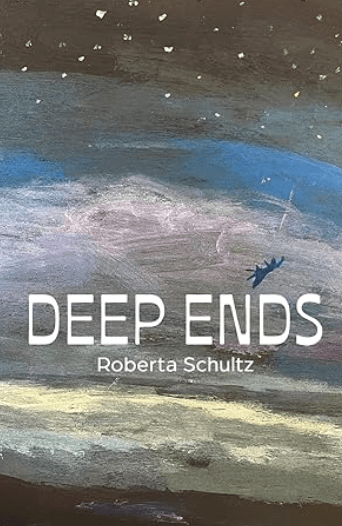
Water is the controlling metaphor of singer-songwriter-poet Roberta Schulz’s latest full-length poetry collection, as evidenced by the title and by the section headings. Besides Deep Ends, there’s Wade in the Water, The Water is Wide, and By the Waters of Babylon. And there are currents. The book begins with childhood and family, moves into deeper and wider waters: of career, literary influences, and social consciousness, and concludes with poems in which all that has been learned in the journey is brought to bear on seeing the world and making art.
The title first appears in “Lesson,” the initial poem. The child swims freely until the intervention of Mom and Aunt Marge: “To teach me how to survive, / those traitors tossed me in the/deep end. I gasp for air still.” A necessary lesson, perhaps, for in “The Recipe,” about the mother making soup with few ingredients, “My people left home because there was no food.” Family life in northern Kentucky is rich in detail and worry. In “Cross Chest Carry,” the father suffers from war-related PTSD (“We never lit fire crackers on the Fourth of July”) and is eventually hospitalized. Meanwhile, the future poet explores other cultures. In “Sakura,” a word for cherry blossom tree that also means renewal, “Sweet blossoms of memory scatter, then fade into jangle of Japanese song for new beginnings.” She also connects with her Native American heritage through drumming: “Once in my grasp, the drum/opens doors to heartbeats, to honor beats, to powwows, / to potlatch to hoop dance, /to grass dance and ever-widening circles” (“Tlingit Drum”). “Whitewater” is one of several poems about the loss of a sister (“. . . I cannot fish goodbye/from these swollen/rapids”) and about trying to find words for such sorrow. “Strange poems/rattle /from wounds this deep,” she says in “Divining.”
As she did in Underscore, Schulz engages with art and artists she loves. In the section “The Water is Wide,” she plays with the lyrics of Frost’s “Mending Wall,” talks to Margaret Atwood, is inspired by the example of Dolly Parton when her car breaks down: “A sleek and can-do woman jumped out/of my car, hoisted thin rusty metal/from the road, lashed it to the axle/with her matching beaded hair tie.” (“Interview”). Not to mention referring to Emily Dickinson charmingly as “Auntie Em.” In “Drum,” “Cadence triumphs over chaos. / When we mark time/as heart beat, we/begin together.”
In the third section, “deep ends” reappears as the title of a poem about the author’s father (“Always a floater who rises again when/he tumbles head-first into deep ends.”) A somber mood gains ground, as in the powerful “Live as if You are Already Dead,” but it is often lightened. “The Dead Speak After Hades Floods Over” begins whimsically, “It’s hard these days to ferry souls here to Elysian Fields. /River, what river?” “My Hands Trust Love” argues for choosing the positive and going on. Each couplet begins with “My hands trust love,” including the one for “my sister, ’who flowers in life and in death.” The final lesson in this book, which like all good books is about how to live, is found in “I Heed Wendell Berry’s Advice About How to Poem,” a reference to his well-known poem, “How to be a Poet”. Every couplet of Schulz’s poem ends with the word “silence.” Like Berry, she is saying, Be quiet. Listen. Finally, let go of words and be. Indeed, the last poem in this intelligently organized volume, “Poem Begun with a Line from Denton Loving,” ends with the advice “forget /soft litanies. Sip stillness.”
 Pegasus