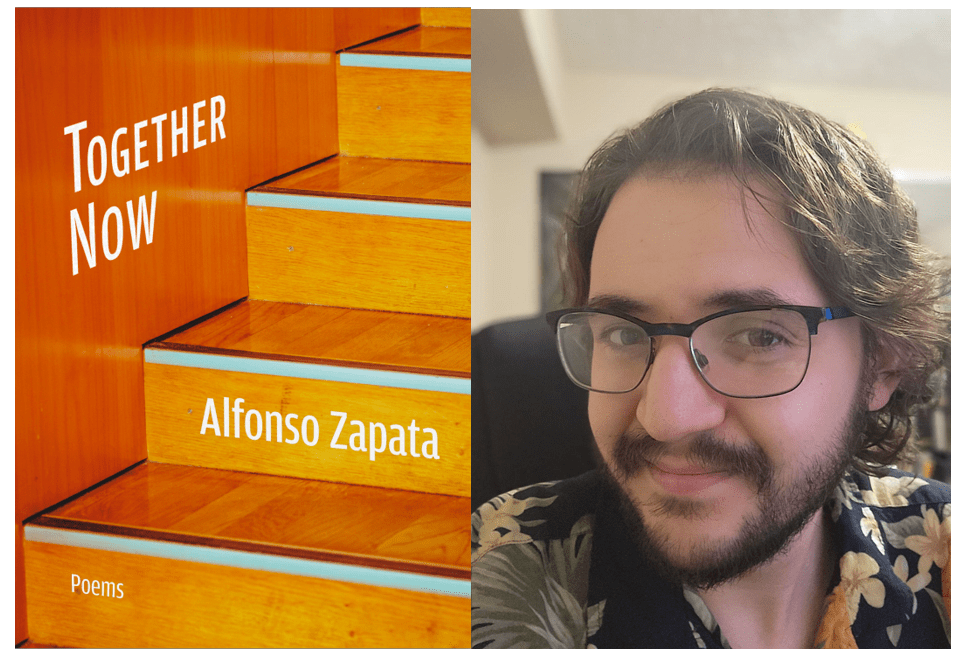
We are more than pleased to share this interview with Alfonso Zapata, filed by new Pegasus Editor Susanna Spearman. Alfonso Zapata is a poet living in Lexington, Kentucky. He received his MFA in poetry at The University of Kentucky, and has attended The University of Toledo and The University of Southern Mississippi, where he obtained his master’s degree in poetry. He has previously received the Jim Lawless IV Poetry Prize, and the 2022 & 2023 University of Kentucky MFA Poetry Awards. His work has appeared in Sho Poetry Journal, and his first full book of poetry, To Pay for Our Next Breath, will be released in Spring 2025 by Texas Review Press.
How did you find your way into poetry? Feel free to interpret this question however it strikes you.
In the second grade our teacher had all of us write page-long short stories and while it seemed like most of the students just stuck to the assignment (like normal people) I just kept writing, ending up with about a four page long horror story. The teacher and my parents immediately encouraged this and I got it in my head that I wanted to write short stories. When we focused on poetry in high school, though, I hated it. The way it was taught, or the way I took it, made it feel more like math than the stories I loved to read and write. When I got to college, my first creative writing course was basically a stealth poetry workshop. I almost dropped the course at the time, but the instructor, James Thomas Miller, a poet himself, brought in poetry from people like William Matthews, David Wojahn, Rodney Jones, and Elizabeth Bishop that all hit me in a completely different way.
The melding of the careful language and linework with narrative through-lines, the thing I was always looking for in art, endeared me to the medium so quickly. Miller apparently saw some potential in the first poem I submitted, and even after the semester had ended he continued to push me to write more and gave me tons of books to read, even got me a pretty hefty scholarship to help me focus on the writing. He’s basically the reason I found poetry, and even though he passed away before I got any work published, I still constantly think back to the way he taught poetry and try to emulate his enthusiasm for it.
Do you feel like you exist on the fringes of many groups and identities? If so, do you feel this contributed to you becoming a creative?
One of the major themes of my chapbook and book is the feeling of belonging, and this anxiety or fear of not really fitting into a group has basically been in me since I was born. My father’s side of the family came to the US from Mexico in the 80s, and my mom’s side of the family has been mostly in Ohio for as long as I can tell. On one hand I am much closer with my dad’s side of the family just on a geographical level: I grew up next door to my godparents and cousins, and next door to them were my grandparents. But I have always felt like the odd one out, as my brother and I are really the only ones on that side of the family who don’t speak Spanish, as we weren’t taught as children. And while our family has always been extremely kind and caring to us, it has always felt like we were Mexican, but not Mexican enough. A clear example of this is my name: I’m named after my father, and he’s named after his father. But I am never called “Alfonso” on that side of the family, I’m called “AJ”, an abbreviation of my first two initials. While everyone has nicknames in this family, mine feels like an unintentional othering (a problem entirely in my head, but still something that used to bother me).
My mother’s side of the family (not my mother herself, she and my father have always been the most supportive people) on the other hand have always been difficult, as they fall on the highly conservative end of the political spectrum which has led to some very uncomfortable disagreements, especially concerning their statements about Mexicans despite knowing where my father is from. As well, that side has tended to be distant and unaccommodating, but also judgmental over the fact that we don’t reach out enough, as if they are owed our company. On a literal level, I should identify more with this side of the family: I pass as white, and have never been to another country, let alone Mexico where the other side is from, but even if I wanted to, I still don’t fully belong to this group either.
This conflict has always been at the back of my mind, and I could never really clearly let it out without feeling like I am completely shutting out or disrespecting either side of my family. But when I needed an outlet, I started writing. I felt like I could put words to this nebulous discomfort, maybe hide behind the idea of “artistic license” or metaphor to fully process my feelings in poetry, which I feel is the ideal way to access the root of my thoughts and feelings without having to feel like I am fully confronting someone.
Alfonso, talk to me about Selena!
I am basically always waiting for someone to ask me the Selena question, so thank you for playing into my grand scheme. Growing up, basically every day we would be visiting my grandparents or aunts and uncles, and all of their houses were always blasting latin music of some sort. From the younger family members who came to the US from Mexico at an earlier age, the two worlds fused and that came out in their musical choices, and Selena was just the perfect representative for that sort of life.
As a very young kid I didn’t know Spanish (I still really don’t) but I could sing along, I knew those words, I still could sing all of “Como La Flor”, I still do when it comes on at family get-togethers. And she died over a year before I was born. She was this young, absurdly talented and natural performer, she sang a lot in Spanish and had Mexican family, but she was born and raised in Texas. And she had such a hold on the world, she bridged these two worlds just with her art and ability, literally in terms of just how wildly popular she was in America; if you look at her Astrodome performance maybe a month before she was killed, that place was absolutely packed, I think that show is still one of the top five most attended events there.
It’s a running sad joke in our family to wonder if the US’s sickeningly negative opinions about Mexican immigrants could have been improved even slightly if she was still with us, still being an unignorable icon and face of people who are so frequently dehumanized. So I obviously had to write a poem about her, and it’s probably the one that took me the longest to write by far, but it’s also potentially my favorite piece of writing.
Who are your favorite poets right now?
My current favorites are kind of all over the place, mostly ones I’ve been a fan of for a long time. Frank X Walker (who was also the head of my thesis committee, so there is a bit of a conflict of interest here I suppose) just put out a new book Load in Nine Times which is absolutely incredible. Roger Reeves is another poet who I just keep coming back to, same with Eduardo C Corral, Patricia Smith, and Ilya Kaminsky. But to be really annoying, I have to say the most enjoyment I’ve gotten from poetry recently has just been reading the work of my friends. Fellow USM grad Todd Osborne released his first book Gatherer this year and it is just wonderful. We’ve all graduated but a lot of us still keep in contact and share poems and hold little workshops. So many of these friends get thanked in my book, but I’m doing it here too: Kate Arden, Jazmin Witherspoon, Clay Shields, Lucy Jayes, Deidra White, Yusuf Akman, NitaJade. Everyone should write those names down, these are all amazing poets that we’re going to be hearing a lot from, if we haven’t already.
If someone could only read one of your poems to get a sense of your work, which poem would you send?
Not to keep going on and on about Selena, but the poem “Como me Duele” is the thing I’m most proud of, and the one I think is the most representative of how I like to write. It really feels like my greatest hits; it’s in a weird, complicated form, it’s about music, it’s about my family, and it’s got a feeling of a sad celebration, and I think that is the vibe I want to put forward whenever I write a poem.
 Pegasus
Leave a comment