
At Pegasus we draw great pleasure in celebrating the work of our colleagues. Although Book Beat only reviews poetry, we will be happy to announce books members publish in other genres. If you are a member of the Kentucky State Poetry Society and interested in having a recently published work reviewed for publication in Pegasus, please contact:
Elaine Fowler Palencia
3006 Valleybrook Drive
Champaign, IL 61822
(217) 621-1093

B. Elizabeth Beck, Dancing on the Page: Poems. Versailles KY: Rabbit House Press, 2024. 74 pp. $20.
Beck’s latest poetry collection reads like a novel in which every chapter is a ballad, and why wouldn’t it? The music she has loved for decades hums continually in the background, beginning with the introductory poem “If.” Its epigraph is from Velvet Underground’s Jenny.: “Jenny said, when she was just five years old, there’s nothing happening at all.” In Lou Reed’s song about Jenny, “You know her life was saved by rock and roll.” In Beck’s prose poem, the author is “escaping parents who should have been the death of us all. I’m still wondering how I’m alive.”
Not only are song lyrics quoted and bands frequently mentioned, but other cultural references identify Beck as a “Child of the 70s,” a poem that includes references to the song Afternoon Delight, Reece’s cups, Rhinestone Cowboy, the Age of Aquarius, Jethro Tull, Cat Stevens and Little Feat. The energy is building, the journey motif is gathering strength, so we want “to get on the bus, then jump on the train & never look back” with her.
The personal story that emerges is of a girl propelled by an unhappy homelife to leave this brokedown palace and seek joy on the road. She will follow bands, particularly Phish; but the Beatles and the Grateful Dead are also large presences. “Follow Penny Lane” is made of song lines that take you “to strawberry fields . . . around dark side/of the moon . . .” and on to “The long and winding road” that “leads beyond the world of Beatles/only if you choose.”
“Midnight Sessions in the Studio” jumps us to the mid 80s, boys, and drugs. “Finding Your Place” touched this mother’s worrying heart with its description of young concertgoers toked up, seeking community with such hope and finding it among strangers “creating a universe within chaos.” James Taylor, jazz, Smokey Robinson lead her on. But this is the real world, after all, and there’s real risk: “Never marry the coolest guy at the show.” warns a title. Too late. Happily, “Forever Husband” will save her. Subsequent poems are different in tone, more spare and more confident. “If you want to marry me” is a list poem of commands, beginning, “write a poem that kisses/me so deeply, I lose my mind.” These later poems also think more about the writing of poetry and self-interrogation. “In the Neighborhood” confesses, “ . . . existentialism has failed me. Instead, I’ve become a nihilist.” There is purposeful exercise. The grownup world. A closing of a circle that began in childhood, that finds her teaching children. In “Teach,” painting dance, and rock and roll come together: in the classroom, “not desired outcome/on institutionalized curriculum/but a lesson they’ll never forget.” “Teen Howl” honors Beck’s work with her youth poetry series of that name, where she finds “voices lifted under applause sweeter/than any show I’ve attended.” What a sweet homecoming.
The final section, “Breathe, Breathe in the Air,” returns to concertgoing, but with a difference: there is a son to factor in; plus, the experience is just different when one is older. “Phoenix, Arizona, October 2022” takes her to a Phish concert where she is haunted by a ghost “of my own design” and finds herself weeping.
A subtext of self-affirmation emerges as the book draws to a close. It finds its voice in the last poem, of which the title is also the first line: “Old Enough Now” “to not care what they think/dance like it’s the last time/feel the same childhood joy . . . Nobody else will ever remember/ you, Everyone too consumed/ in their own reality . . . so, let it all go and dance/with wild abandon . . . while I sway to my own groove, /sending love to you.”
Applause.

Dorian Hairston, Pretend the Ball is Named Jim Crow; The Story of Josh Gibson. Poems. Lexington KY: University Press of Kentucky. 2024. 104 pp. $21.95.
Josh Gibson, one of the greatest baseball players this country has produced, was born in 1911. In 1929 he married Helen Mason, who in 1930 died giving birth to twins that survived. She and Josh were eighteen. Gibson played in the Negro Leagues, as well as in the Caribbean and in Mexico before dying of a brain tumor in 1947, three months before Jackie Robinson broke the color barrier in major league baseball. All this and more Dorian Hairston sets out in the introductory note to his first poetry collection, reminding us “ . . . the stories we tell ourselves about the past are far less interesting than the truth.” He aims for the truth about the consonances between American history and baseball.
From this heroic, tragic story, Hairston has captured the voices of those who were there, which he shares in masterful persona poems: Josh Gibson himself; Helen; their children, Josh Jr. and Helen Jr.; Hooks Tinker, a player and manager who discovered Gibson; Satchel Paige; Chester Washington, a white newspaperman; and even Gibson’s baseball bats.
The title, “Pretend the Ball is Named Jim Crow,” appears in the first poem, “Manifesto for Black Baseball Players.” Spoken by Gibson, this list of commands establishes a tone of righteous outrage: “steal bases like they/stole this country,” “(de)colonize/the hall of fame,” “never be controlled/by anything white.” The poems that portray his relationship to Helen provide an emotional contrast. Heartbreakingly sweet, they, too, are about loss—the lost future of the family. Alive, Helen is accorded a single poem, “Naming,” in which she learns she is having twins and plays with naming them. Then comes “Home Run #1,” a letter to the deceased Helen from Josh. He imagines lacing letters to her into baseballs and hitting them towards the stars “’Til god get tired of all them broken windows/up in Heaven and bring me there too.”
The children grow up with nightmares about their birth, and with the family stories told by their father of his parents leaving ultra-racist Georgia for the north. In “Mother and Daughter,” Helen Jr. sees a woman and little girl in the street and yearns to spend such time with the mother she never knew. Meanwhile, Gibson plays his way into black baseball stardom. In “Uncovered,” Hooks Tinker recalls his first sight of Gibson playing at sixteen: “I never seen something so smooth./how Josh didn’t rock or sway back/ before the pitch, he just waited there/in the box like a snake to strike/with hands so fast that/ from left field you/could hear the wind jump/out the way.” The imagery throughout the collection nails America’s racial history. In “The Original Dodgers,” Hooks says, “Jackie Robinson/was never the first Black Dodger./we done dodged balls for centuries/rent, lynch mobs, overseers, slave catchers,/ waded through fixed elections, and rivers,/ done outrun horses and bloodhounds,/ even dodged some bullets a few times.” Then, when white baseball realized that black players might make them some money, “ . . . they came over to our fields/in they Model T’s shaped like spanish/ships . . .” and “they planted their feet on African-/built shores . . .” The efficiently titled “Outfield Cot” tells how black traveling teams often had to sleep outside, many hotels being for whites only. Gibson notes in “Can’t Compete,” that with all the excuses for not playing black players in the majors—they aren’t good enough, they’re corrupt—“they just admitted they scared/to get they ass beat/at they own game.” He protects his children as well as he can, disciplines them, and teaches pride.
The politics may seem simple—black/white; but they never are. For example, Gibson and other American black players enjoy playing “race-free baseball” in the Dominican Republic, where they are welcomed by long-time dictator Rafael Trujillo. And “aint that some type of nonsense?/ Trujillo liking Negros, more than Roosevelt.” But the poem that tells us this is titled “Perejil,” a reference to the Parsley Massacre (la Masacre del Perejil) of the same period (1937), in which Trujillo had over ten thousand Haitians murdered, because he could.
The book is divided into innings, ending with “Extra Innings,” three poems that take stock of our poetic journey: “Cooperstown,” in which Hooks Tinker relates how far we still need to go in recognizing the contributions of pre-integration black ball players; Helen Gibson in “Where We Go,” still missing her husband in the afterlife; and the author, who played baseball at the University of Kentucky, talking to Gibson in “The Walk Off,” or “I visit Josh’s Grave,” baseball player-to-baseball player.

Sandra Rippetoe, Lucky in Kentucky: A Squirrel’s World. Harrodsburg KY: Nature’s Rhyme. 2024. Unpaged. $11.99.
Well, if this book isn’t cute as a bug’s ear, I don’t know what is. Each page of this rhymed picture book, told by Lucky the squirrel, features a photograph taken in a natural setting in Kentucky: Creasey Mahan Nature Preserve, Goshen; Josephine Sculpture Park, Frankfort; Old Fort Harrod State Park, Harrodsburg. Alert readers will recognize the sprawling tree on the cover from Fort Harrod.
Lucky takes us on a tour of his world, a hand-drawn map of which appears on the end papers. E.H. Shepard’s map of Winnie the Pooh’s Hundred-Acre Wood comes to mind. He introduces himself with a shot of him looking at the camera from the crotch of a tree. “Welcome to my world . . ./a nature preserve in Kentucky./Mama Squirrel knew this place was special./That’s why she named me ‘Lucky.’” Each page identifies its subject by common name and scientific name. Above Lucky’s introductory photo, we find “Eastern Grey Squirrel (Sciurus carolinensis).” Of a photo of a snake peering over a log, Lucky says, “Hissy is a shy slithery snake/coiling in weeds, trees, and in-between. / She can make a meal of me. / I would rather not be seen.” Then we read that Hissy is a Gray Rat Snake (Pantherophis spiloides). Lucky’s home is in a chinquapin oak (Quercus muehlenbergii). Lucky takes us to meet frogs, turtles, bees, a rabbit, skunks, and plenty more. He points out an Eastern White Pine, a brook, and his cousin Rustypaw.
After children read this cheerful book, which teaches so much about nature, they will want to play outside, pretending to visit the Stalking Ground of Meadowbell the housecat, and Butterfly Meadow, hunt acorns like Lucky, and maybe climb a tree.
For children of all ages.
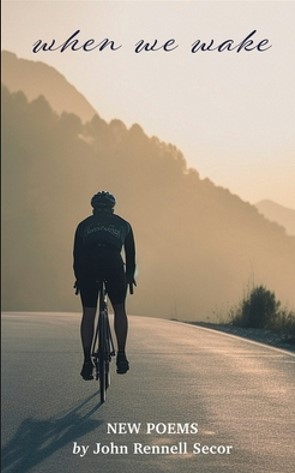
John Rennell Secor, when we wake; New Poems. Sarasota FL: The Peppertree Press. 2024. 126 pp. $16.95.
What do Toronto, Poughkeepsie, Paris, and small-town Kentucky have in common? For one thing, the life and poetry of John Secor. His latest book of poems begins with his Canadian childhood and follows a multi-cultural journey to a teaching career at Morehead State University, and beyond.
The first of four sections, Milestones, starts with the young John learning to ice skate at seven. “becoming a poet,” the next poem, reveals another lifelong passion that began the same year: “I’m going to be an author/ there was no doubt in/my seven-year-old mind.” The fables of Jean de La Fontaine inspired the decision. Since then, the poet has been “chirping like La Fontaine’s/cricket while the sun shines.” In due time, first dates come along, “under the star of the late Marvin Gaye,” as one title has it; then college in the U.S and back to Canada, where “the air was always fresher;” and eventually fatherhood and family in the States.
The choice to print the poems mostly without caps, even in the titles, and no punctuation, gives them a deceptively modest, unassuming air. But there is depth in these meditations upon life lessons and social concerns. Two poems, for example, remember the victims of the mass shooting at Marjorie Stoneman Douglas High School.
In a note, the author explains that the section “On Famous Women” aims to “highlight moments of courage and pathos among contemporary women,” some public figures, some not. In “a lesson for our time,” a woman hurls a satisfying insult at Fidel Castro. “no-knock warrant” remembers Breonna Taylor’s murder. “after seeing the musical Next to Normal in 2018” recalls a friend who took her own life. The war in Ukraine appears in “HOME! I hear her say on NPR.”
The poems become quieter the deeper they go.
The third section, Dream-Vision Poems, looks back to Christian mystics, to whom revelations arrived in dreams. But Secor’s dream visions can be also be daytime memories, which suggests that our whole lives are a dream (La vida es sueño, as Calderón said). Dreaming appears throughout the book and points towards its title.
The final section, There and Back Again, travels between Kentucky and Paris. “born in Poughkeepsie raised in Toronto” establishes the author’s Kentucky bona fides, being a list of the out-of-the way places he’s visited during thirty-five years in the state as a professor, member of a barbershop quartet, driver for a van of actors, father, soccer referee . . . at the end of which he asks mildly, “isn’t Kentucky my land.” As for Paris, four poems, two in English and two in French, are paired by the same subject matter. Two center on a blind woman and her companion eating escargots at a Parisian restaurant. They are not translations, one of the other, but each poem uses the same material; they are separate but related treatments. The same strategy is employed in the pairing of “la Vénus de Milo” and “Vénus in the Louvre.” Anyone interested in what difference the choice of language makes, will be fascinated. The last poem, “growing up in East Kentucky,” relates a chance meeting with a man who once played on a youth soccer team coached by Secor. Two very different people, but the connection is immediate and heartwarming because of their long-ago history. As the last line says, “we are all kin through experience.”

Katerina Stoykova, The Poet’s Guide to Publishing: How to Conceive, Arrange, Edit, Publish and Market a Book of Poetry. McFarland & Company, Inc. Jefferson NC: McFarland & Company, Inc. 2024. 179 pp. $19.99.
This is an easy book to describe, because it is so logically arranged. It is a supremely useful book for any poet wanting to publish a book of poetry, because of the wealth of experience the author has accumulated as a working poet, founder and senior editor of Accents Publishing, director of the Kentucky Book Festival, director for the Center of the Book in Kentucky, and host of the Accents podcast on WUKY in Lexington. It provides a firm hand to hold while proceeding through the stages, mentioned in the subtitle, that will bring your book to market.
But it may take you out of your comfort zone. Many writers love the privacy, the introverted life, of creation. We like sharing our work with small, generally knowledgeable and sympathetic groups of other poets. The hard business of crafting a sellable product, and then actually selling it, requires a different orientation towards the work and different skills. Not to worry. Help is here.
The book is divided into five sections. Concept explores such topics as The Three Aspects of Writing Poetry (Instinct, Technique, Obsession), then how poems begin to group themselves into series, and how to recognize such trends in one’s work as a collection coalesces. Here the poet learns how to see trends and themes in their own work, and to make decisions about which poems resonate with others and belong together. One of the strengths of this book is that it doesn’t insist on a single way of doing things. Suppose you’ve tried to find a theme in your poems that can unify a manuscript, and you can’t. Read the short section, “If You Cannot Find a Theme,” on page 24.
Part 2, Arrangement, gets into the nitty-gritty of organizing the poems into a whole. Arnold Toynbee supposedly said, “A story is not just one damn thing after another.” Neither is a collection of poems, as Stoykova shows. What about “bonded poems,” for example? Say, you have one poem that asks a question, and another that provides the answer. This is one example of what to be aware of in sequencing. What about the first and last poems in the manuscript? Choice is particularly important here.
Part 3, Revision, is perhaps the most difficult piece of the process; because you may think you’re done, the poems all chosen, but you’re not. A revision checklist, that helps you re-examine every aspect of the “finished” manuscript, will refine it immeasurably. Gaps show up. Do you need to write another poem to fill it? Part 4, Publication, includes such helpful features as where to meet publishers, where to submit the manuscript, what to look for in a publisher, and, employing that useful reverse way of looking at things, a section titled, “What Doesn’t Help.” Self-publishing is also explored. First-time authors and much-published writers will both benefit. Section 5, Promotion, suggests multiple strategies for getting your book noticed, even stretching to “After the Book Has Been Out for Some Time.” Bottom line: You can’t be shy. You have a responsibility both to your book and to your publisher.
Each of these sections ends with “Qualities Needed at This Stage.” Here the writer can identify their own psychological strengths and weaknesses, and plan how to utilize the one and compensate for the other in order to accomplish the differing goals of each stage of the process.
Throughout the book, Stoykova sees writing as an ongoing act of revision. So, it’s not surprising that her book ends with an Appendix full of Extras, including the useful “Obstacles, or How to Not Write Your Book,” which cheerfully explodes our little strategies for self-sabotage.
For an excellent example of how to arrange poems in a full-length manuscript, see Stoykova’s latest collection, Between a Bird Cage and a Bird House (reviewed in spring 2024 issue of Pegasus).
 Pegasus
Leave a comment